Wednesday, 11 November 2009

Armistice Day

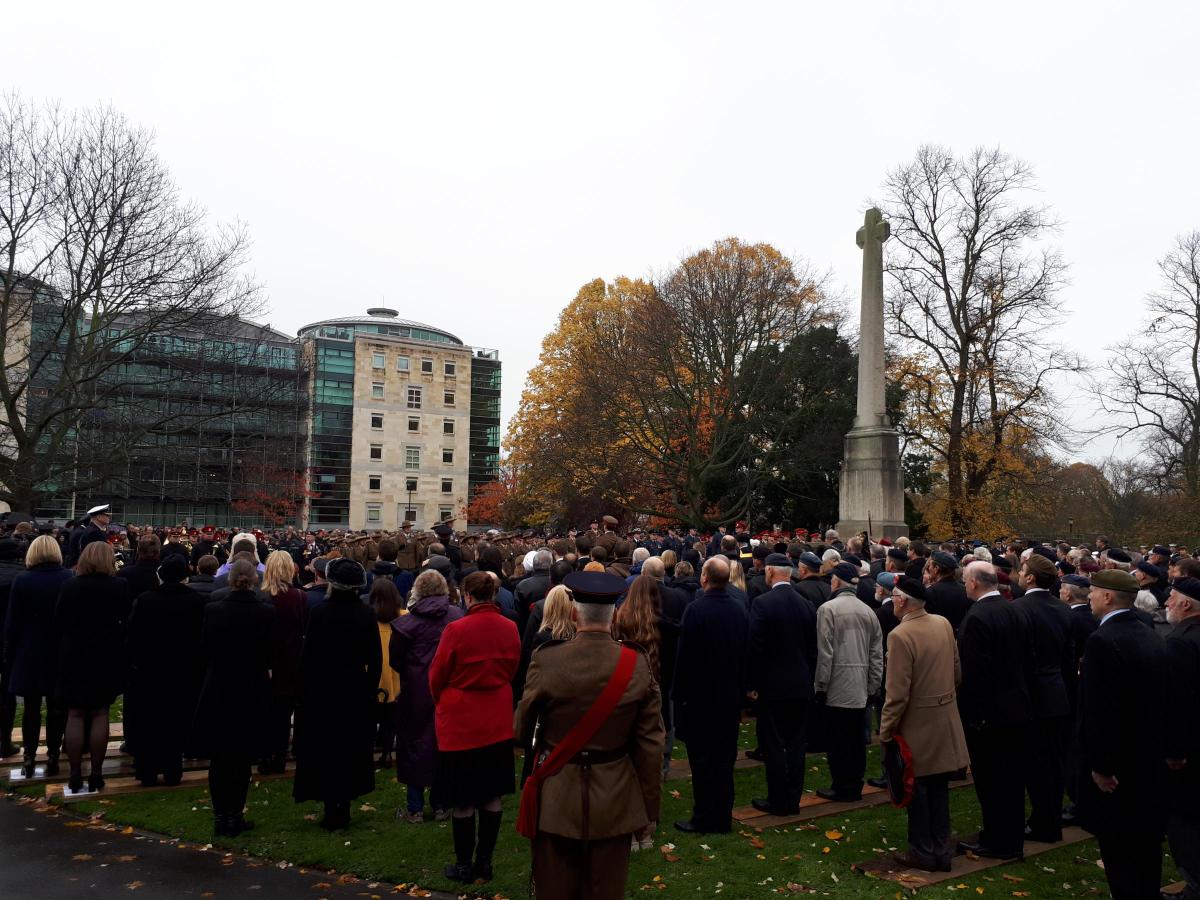
Today is the first time Armistice Day has been remembered without any World War I veterans attending the ceremony at the Cenotaph. The last two British veterans of the war, Harry Patch and Henry Allingham, died earlier this year.

As a child I remember watching the Remembrance Parade on television, and enjoying the march past of the former soldiers from both World Wars; the lack of WWI veterans this year is a stark reminder of how both of these momentous events are slipping away from living memory. Even the numbers of World War II combatants is increasingly tiny and physically frail.

For anyone growing up in England over the last thirty years, both wars will loom large in their cultural memory. Many people study the war poets at school: Wilfrid Owen, Siegfried Sassoon, Robert Graves and others. There were also the direct personal links with those who’d lived through them and experienced loss. My grandmother lost four male relatives, including her father in World War I. My great-grandfather got a medal for shooting down the first Zeppelin over London (even though he was stuck on a train at the time). One of my grandfathers served in India, whilst the other repaired tanks in Egypt: my great uncle came in on the beaches at D-Day. I have a photograph of a family wedding from during the war; it was a large family and every single male was in military uniform. It’s difficult from our modern perspective, when the wars in Afghanistan and Iraq seem impossibly remote to imagine the extent to which these wars permeated all aspects of life and how they impacted on life and society after the war; my great grandmother struggled to bring up two children single-handed in London in the 1920s. Even though all these things are slipping away from immediate personal experience and memory, its worth pausing for a moment or two to remember them


Family Roll of Honour

Private James Patrick McManus DCM, 2nd Bn, Kings Own Scottish Borderers, 6th May 1915

Private Patrick Canavan, 1st Bn, Royal Irish Fusiliers, 10th May 1915

Private Albert Hollowell, 24th Bn, London Regiment, 28th October 1915

Sapper William Hollowell, Inland Water Transport, Royal Engineers, 24th January 1919

Tuesday, 27 October 2009

Archaeology and the BNP

Interesting piece of comment arising out of last week's Question Time in today's Guardian

Having been poking around some of the seemier (politically) ends of the internet over the weekend, it's interesting to see what use the BNP/Far Right is using of archaeology. Particularly, they appear to have picked up on the work of Stephen Oppenheimer who has used genetics to suggest that the British population has its origins with pre-Celtic populations and was not profoundly influenced by later migrations. (NB: that is a very broad characterisation of his more subtle argument; its also important to note the Oppenheimer has publically disavowed the racist/political spin put on his work by the BNP. It is of course possible to make a critique of Oppenheimer on technical grounds (though I'm not particularly well-placed to do this); however whether accurate or not I am interested in the way in which his work is being used.

Essentially, the BNP are arguing that this means we can clearly distinguish an 'indigenous' British (which they often gloss as 'English') population which they see as countering the argument put forward by many of those who are anti-BNP that Britain has always been a melting pot, with great genetic diversity (thanks to 'Celtic', Roman, Anglo-Saxon, Viking, Norman etc interbreeding).

The problem with the BNP use of Oppenheimer's work is that they elide the notion of race as defined by genetics/descent and the notion of a people/ethnic group, as defined by cultural practices. So, if we accept that Oppenheimer is right, then the BNP have the problem that although there is a broadly genetically homogenous indigenous population in the UK, its cultural practices have continually been reworked by incoming cultural groups. Whatever the current debates about the size of Anglo-Saxon migrations, it is pretty clear that the 5th-8th centuries saw a profound 'germanicisation' of much of lowland England. The far right then have to accept the fact that Anglo-Saxon society (in its archaeological sense and in its modern politicised sense) is something that has been imposed on an indigenous population. Thus, it makes it hard for them to criticise on an a priori basis the notion that externally derived cultural change is a 'bad thing'. On the other hand, if they reject Oppenheimer's work (or it becomes discredited), they have to accept that actually, our 'pure'/'indigenous' population is nothing of the sort.

However, I suspect that detailed exegesis of the current work on population genetics and archaeological culture theory is not at the top of their minds. However, this is an excellent example of how archaeology (in its broadest sense) is being used to fuel pressing current political debates.

Monday, 12 October 2009

More on Norman churches...

The first blast of the beginning of term is now over, so I’ve finally found time to have a bit of a think about the results of my initial fieldwork in Western Normandy which I’ve blogged about previously.

Essentially, I’m interested in exploring the development of early Christianity in the Cotentin peninsula in West Normandy; this is a border region between Normandy and Brittany. The received wisdom (primarily based on fairly limited documentary evidence) suggests that in the pre-Viking period (ie pre-10th century) there were only a small number of ecclesiastical sites in the region incuding Portbail, Orval, Coutances, St Marcouf and Le Ham (near Valognes). These are assumed to have fallen into abeyance following Viking raiding, with church organisation only reviving in the 11th century. Although little has been written about the rise of the parochial system there is a general assumption that this only falls into place in the 11th/12th century, although this has never really been tested.

My current working hypothesis is that there are two problems with this existing story. First, I am suspicious of the fact that in the pre-Viking period there were only around six ecclesiastical centres. For example, in England, County Durham (an area of comparable size) has around fifteen known pre-9th century monastic/church sites. I believe that there is enough reported archaeological evidence (primarily in the form of Merovingian burials) from later church sites to argue that they had pre-Viking origins. Of course, I am making some key assumptions here, particularly that this reported evidence is indeed of pre-Viking date. One of my key tasks now is to go back to the original (mainly antiquarian) publication of the evidence for early activity on later church sites to assess its reliability – luckily thanks to the Society for Church Archaeology I have a small grant which will allow be to visit the British Library and the Bodleian Library to consult the relevant publications.

My second suspicion about the current narrative is that there was a large-scale disruption of Christianity in the region following Viking settlement. I have no problem with some sites being raided and temporarily falling out of use, but I’m not convinced there was a complete abandonment of the churches until the 11th century. Again, based on the presence of pre-Viking activity on later church sites I would argue that there is continuity straight through. Otherwise we’d have to argue that the memory of the location of church sites was preserved for at least a century and then when Christianity was re-established the churches were revived on the original locations rather than new sites.

I am also interested in the spread of parishes. I am happier that the 11th/12th century date posited is correct. However, I think there is a still a need to provide more hard evidence. One way of exploring this is through looking at the provision of churches in this period. This can be done using the limited documentary evidence and the architectural evidence. The charters issues by the Dukes of Normandy are of some help; a number of churches are mentioned in the grants they made, particularly to abbeys, in the 10th and 11th centuries; although it is noticeable that there are geographical variations in the evidence for these churches. For example, quite a few are recorded in the central Cotentin (Barneville-Carteret; Valognes; Briquebec areas), but far fewer in the north. How does this correspond with the evidence from the churches themselves. Well, again, there is a traditional narrative here. Most overviews of early Romanesque architecture in the region (broadly speaking 11th-12th century AD) limits themselves to a fairly limited number of sites; primarily those which contain large quantities of Romanesque sculpture or extensive areas of fabric (for example, Tollevast, Martinvast; Octeville; Brucheville). However, my gut feeling, based on previous visits to the area, was that, in fact, there were many more churches than that which preserved at least some early Romanesque fabric (based on the presence of various diagnostic features, such as the use of herring-bone masonry and monolithic stone windowheads. Thanks to a grant from the Society of Medieval Archaeology I was able to spend some time out in the region in September doing a rapid but systematic survey of churches in a number of sample areas across the Cotentin. I looked at around 140 churches and recognised a far higher level of existing fabric of this period than had previously been suspected (you can see lots of images here. It was interesting to note how poor the local understanding of church architecture could be; for example, at la Haye D’Ectot. , the information board firmly stated that the building was built in the 18th century, despite the clear presence of 12th century fabric in it! .

Although there is still much of the area to survey, it is clear that the documentary evidence significantly under-represents the provision of churches in the area in the 11th/12th century. There are a number of areas, such as that around the Sienne estuary, where there are entire blocks of parishes which have churches with 11th/12th century fabric, suggesting that the parish network was established by this point.

So, still lots of work to do pulling together all the documentary and antiquarian evidence together. I'd also like to explore the landscape context of the churches in a little more detail at some point: many of them are in hilltop locations and in some areas they are often located well away from the modern villages.

Thursday, 27 August 2009

Early Christianity in Western Normandy

I've not really written much about my archaeological research on this blog so far. However, I'm getting ready to head of to Normandy in a few weeks to do a small-scale pilot project on early Christianity in the area (thanks to a grant from the Society for Medieval Archaeology), so I thought I'd include a little bit about my current plans (ie I've basically cut and paste a chunk from the grant proposal)

Mapping the early medieval church in Western Normandy: AD400-1200


This project aims to begin mapping the evidence for Christianity in Western Normandy using archaeological and architectural evidence to supplement the sparse documentary material, with a view to developing a better understanding of the evolution of the Church in this understudied region. The Cotentin peninsula (forming the bulk of the modern Département of Manche- roughly coterminous with the diocese of Coutances) was a border region throughout the early medieval period. Whilst the initial evangelisation of the area was carried out in the late period by the bishops of Coutances (the Roman town of Cosidia) it is clear that the early church in the area was strongly influenced by missionary activity from Brittany and Ireland; for example, the monastery at Orval may have been founded by Columbanus. From the 9th century the area saw considerable political disruption following extensive Viking raiding and then settlement along its northern and western coast. The political and social unrest this caused saw it fall under the first the political control of the Kingdom of Brittany and then the Duchy of Normandy, though it was physically and politically peripheral to both polities. The ecclesiastical structure saw extensive disruption in the later first millennium; the see of Coutances fell into abeyance in 866 following Viking attacks and was not re-established fully until 1049. The politically peripheral nature of this area and the impact of Vikings mean that documentary evidence for the region before the 12th century is sparse and consists mainly of sources from outside the area. Any attempt to reconstruct the nature and development of the early church thus has to be able to fully integrate the archaeological and architectural evidence (cf Jarry 1998). Pre-Romanesque religious structures are known Querqueville and Portbail (Duval 1995), and a series of Christian Merovingian cemeteries are recorded in the antiquarian literature (Pilet-Lemière & Levalet 1989). However, existing scholarship on the 11th and 12th century churches in Normandy has generally focused on high-status and archaeologically elaborate structures (e.g. Mussett 1967: Grant 2005), particularly within the Norman heartland, east of the River Orne. There has been virtually no research into the survival of early fabric in the parish churches (though see Baylé 1999). However, recent field visits by the PI to the region have made it clear that early fabric does survive in many parish churches. Distinctive features include the use of herringbone masonry, petit appareil and round headed monolithic windows. A number of grave slabs of probable early date have also been identified.Research objectives. The aim of this project is through a combination of desk-based research and fieldwork to map the evidence for the early church in the Cotentin, allowing the study of the development of the religious life in the region to move beyond the limitations of the documentary evidence. The work will address the following questions:
i) How much evidence is there for Merovingian religious activity on later church sites?
ii) How was this activity structured? Was it centralised and limited to a small number of monastic sites or is ecclesiastical provision more decentralised?
iii) Can this be used to assess the extent to which Viking settlements really disrupted ecclesiastical activity in the region?
iv) To what extent does Romanesque and pre-Romanesque fabric survive in existing church structures?
v) How can this evidence be used to understand the development of the ecclesiastical organisation in the region following its integration into the Duchy of Normandy in the 11th century?
vi) To what extent can archaeology be used to explore the development of the church in an area with limited contemporary documentary evidence?

Methodology
The limited historical resources will be used to build up a corpus of contemporary references to churches in the region, which will be complimented by collating the archaeological evidence, mainly from 19th and early 20th century French journals (available in the UK at the British Library and Bodleian Library, Oxford). The fieldwork element of the project aims to map the extent of surviving Romanesque and pre-Romanesque fabric in the existing churches in the area. This will involve two phases of fieldwork. Phase I will comprise field visits by the PI to all churches within two sample areas: an area to the west of Coutances and an area in the far north-west of the peninsula (La Hague). The study areas have been selected to provide contrasting social, political and economic backgrounds in the study period, and to avoid areas of the region, which saw a high level of destruction of churches during the 1944 Normandy landings. Key features will be recorded by digital camera. No permissions are required at this stage.

Phase II consists of more detailed investigation and analysis of a smaller number of structures, selected on the basis of the results of Phase I. This will involve creating a more detailed drawn written and photographic record by the PI and a Research Assistant using a digital SLR camera, hand survey and some photo rectification. Analysis will define key phases of work and seek to identify and interpret early fabric. Once the physical evidence and textual evidence for the early church has been mapped, it will be used as a basis for an attempt to write an overview of the growth and structure of religious activity in the region. Permissions maybe needed depending on sites chosen; will be sought if necessary on completion of Phase I.

Sunday, 9 August 2009

Folk Against Facism

A rather depressing but perhaps inevitable story about attempts by the BNP to co-opt folk music to the fascist cause. Traditionally, the sound track of the far right has been heavy rock/punk e.g. Skrewdriver). However, as the article points out this is not compatible with the new smooth image the BNP are trying to put across now. This has been reported a number of time previously- see here and here. However, there is now the formation of a new body Folk Against Fascism to try and counter the attempt by the BNP to 'claim' folk music as its own (interestingly on its on-line shop the BNP labels it 'British' rather than 'English' folk music). Now of course, I doubt this is exactly going to leave Nick Griffin quaking in his hush-puppies; but its an extremely useful development, if only to remind the Neanderthals in the BNP that the English (and indeed Irish and Scottish) folk tradition is primarily an anti-establishment one, pitted against landed and industrial wealth and imperialism. Its not surprising that ideologically bankrupt and historically and culturally ignorant parties such as BNP should in its typically half-arsed and lazy way try and annexe folk music, and its pleasing to see that those involved in the current folk scene are busy telling them precisely where to stick it.

Tuesday, 21 July 2009

From dots to downloads

By pure chance I caught a fantastic programme on the Radio this morning called From Dots to Downloads about the rediscovery of tunebooks of 17th to 19th century date. These were private notebooks containing a range of music including traditional folk music compiled by local musicians for their own private use. It was presented by Tim van Eyken. The programme particularly talked about the wonderful Village Music Project. Its worth adding that this is not the only excellent resource on-line which brings folk music resources to the wider public. Its definitely worth checking out the excellent FARNE (Folk Archive Resource in the North-East). I was also pleased that it mentioned the importance of folk music to the work of the poet John Clare, a favourite poet of mine (not to mention potentially an ancestor...)

Saturday, 18 July 2009

Mining heritage

Last week Durham saw the annual Durham Miner's Gala: this year it attracted over 100 000 people to the city to remember the grant tradition of mining in Durham. This year numbers were doubtlessly swelled by the fact that it was 25 years since the miner's strike of 1984. The narrow streets were crowded with brass bands from the surrounding mining villages marching along the banners from the local National Union of Miner's lodges. Its an awe-inspiring and moving occasion. However, the elephant in the room (or at least in the streets) is the sad fact that there are now no working coal mines in Durham or indeed the entire north-eastern coal field.

When I was doing A levels, it was common knowledge that the north-east (County Durham and Northumberland) was dominated by coal mining. Even then (in the late 1980s) it was notable that we covered this more in History than in Geography. The process of de-industrialisation may have reached a bloody climax in 1984, but mines had been shutting long before this. So when I started working in Durham and Northumberand a little under a decade ago it was no surprise to me that there was little active mining in the area. What was a shock though was the way the entire industry had been wiped from the landscape. Today, the only pitheads still standing are heritage attractions (at Beamish, Washington F Pit and Woodhorn). I was used to the former industrialised areas of Yorkshire such as Leeds, Bradford and Sheffield, where although many factories and mills were no longer working, the buildings themselves still stood. However, in the north-east the entire infrastructure of a globally significant industry that more or less underpinned entire sections of the regional culture has been entirely erased. It was not only the removal of all the mine buildings that is staggering, but the shifting of the spoil heaps. The spoil pit for the pit at Ashington was once the biggest manmade mound in Europe; its now entirely disappeared. Once in the course of work I came across some photographs of the Durham landscape in the 1950s. There many pictures of many mining villages I knew quite well, but they looked almost entirely unfamiliar because in the background were the spoilheaps standing high above the buildings. The end of the mining industry did not just mean the destruction of the mines themselves but an entire reworking of the landscape itself. I was told recently about the notion of the Anthropocene used to describe the period of earth's geological history when for the first time human's rather than natural processes began to influence the earth's geology and geomorphology. The mining history of Durham is surely a case study in this. Now, though, there is clearly a growing interest in reminding people of the role mining played in County Durham. I think people are realising that babies born during the strike are now in their mid-20s, but have never known the county has a centre for coal production. The Gala, which nearly died in the late 1980s, is now bigger than ever (it's still the biggest regular political rally in the world). Almost all former pit villages have now erected memorials to their collieries. There is a burgeoning interest in oral history and local history; new banner's for the Gala are even being created. Despite all this enthusiasm, there is still a strange and silent gap where the mine's themselves used to be.

There is also a political element to this. I've been told that following the '84 strike, English Heritage wanted to record the historic buildings and installations linked to the mines that were to close. Apparently, however, Michael Heseltine (President of the Board of Trade at the time) actively forbade this; it is hard not to see this as a vindictive act against the miners. The feeling that the mining industry should not be turned into a heritage resource was not, hoewever, simply promoted by the government. Many miners at the time felt strongly that what they saw as a living industry should not be turned into a heritage or tourist attraction. For them the wounds were fresh and the bitterness too raw. Consequently, it is not surprising at the time there was little appetite for protecting or preserving the pit heads.