Thursday, 16 January 2014

Visions of Avebury - Equivalents for the Megaliths

“On a still moonlit night Avebury seems peopled by ghosts, and the old church and cottages of the village seem new and insignificant.” John Betjeman

Amongst my haul of Christmas goodies I got a couple of DVDs – the 1970s children’s tv series Children of the Stones and a set of BBC Christmas ghost stories from the 70s. The latter included Stigma, the first modern ghost story to have been filmed for these series. Both Stigma and Children of the Stone are set in and around the stone circle of Avebury in Wiltshire and involve the interplay between the past and present articulated through and by the stones themselves. Pleasingly a key plot element of Stigma is based on the true discovery of a medieval man buried or crushed beneath one of stones, which nicely brings together the deep prehistoric past, the medieval past and modern life. Crucially, the fact that people still live among the stones is central to the conceits of both programmes. Prehistory is shown to inhabit the present day.

I’ve been intrigued how these very 1970s engagements with the Neo-Romantic aesthetic contrasts with how the Avebury stones were portrayed by major artists in the 1930s and 40s. The key figure here is Paul Nash- one of my favourite artists and one who inhabited the grey area between English surrealism and the Neo-Romantic school of the late 30s and 40s, although he was a little older than the key figures in both traditions. He has been called a ‘green surrealist’, which is a term I like.

He first came to Avebury on a visit in 1933 and took a series of photographs showing the stones. He clearly had a very strong response to the site. He wrote:

“The great stones were then in their wild state, so to speak. Some were half covered by the grass, others stood up in the cornfields were entangled and overgrown in the copses, some were buried under the turf. But they were always wonderful and disquieting, and, as I saw them, I shall always remember them ….. Their colouring and pattern, their patina of golden lichen, all enhanced their strange forms and mystical significance.”

Although in this passage he talks about the process of time covering up the stones, he does not mention the presence of the village that overlies the Avebury Henge. His emphasis on the natural world and suppression of the modern world can be seen in another passage

“'Last summer I walked in a field near Avebury where two rough monoliths stand up, sixteen feet high ... A mile away, a green pyramid casts a gigantic shadow. In the hedge at hand, the white trumpet of a convolvulus turns from its spiral stem, following the sun. In my art I would solve such an equation.'
”

Interestingly, he visited at a time when the stones were being restored and the vegetation cleared. He met Alexander Keiller and they seem to have got on, though he later wrote ““Avebury may rise again under the tireless efforts of Mr Keiller but it will be an archaeological monument, it will be as dead as a mammoth skeleton in the Natural History Museum” – he seems to have been very antipathetic towards the impact of the modern world.

His visit and his photos went on to form the basis for a series of paintings based on Avebury – Druid Landscape, Landscape of the Megaliths , the Circle of Monoliths, Nocturnal Landscape and most abstractly Equivalents for the Megaliths. The interesting thing about these pictures is that they entirely ignore the built environment of Avebury, the village, the manor house and the church. Instead he strips back these accretions to present a purer vision of the stones. He is focussing on them almost entirely in terms of form rather than in terms of their human dimension. The only hint of human activity is in the presence of plough furrows that run up to (and under?) one of the monoliths in Landscape of the Megaliths.

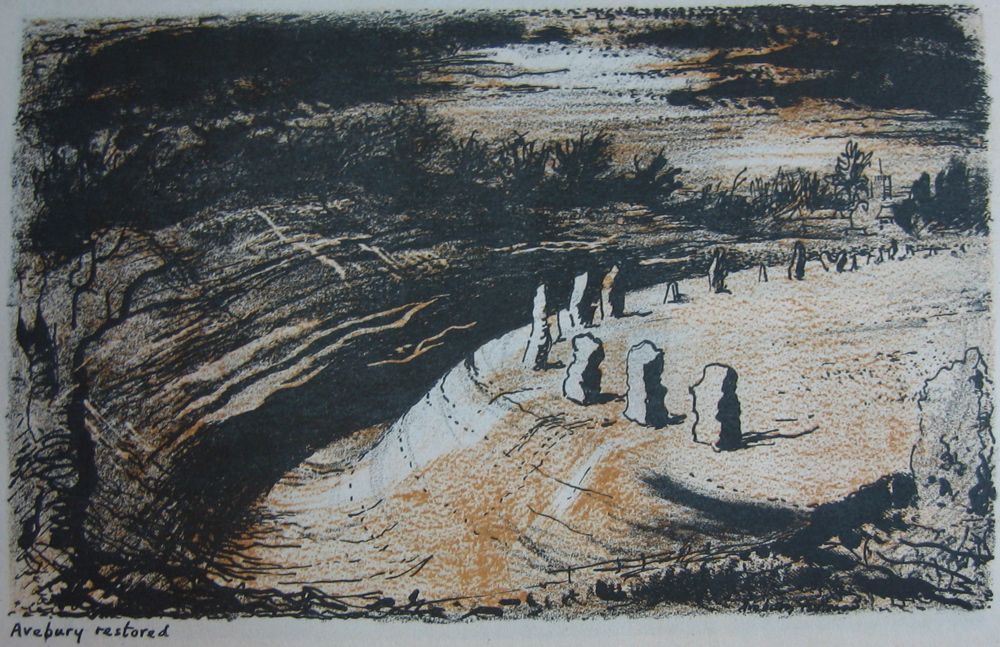
Nash was not the only painter of this period to paint Avebury. John Piper was also very interested in prehistory- indeed he had written a short spread in the art magazine Axis about aerial photography of prehistoric sites. In his paintings of Avebury, he too pushed away the village, although he didn’t entirely excise it like Nash did. In his painting Avebury Restored the tower of the church is just visible in the background. In another meditation on prehistoric Wiltshire he showed Avebury and the Avenue, but the modern world only appears in the form of the skylined obelisk that is the Landsdowne Monument on Cherhill Down. I’m intrigued how Piper and Nash both seem to push out the modern (or indeed anything not prehistoric) in their depictions of Avebury- they seem interested in the deep past, but not in its juxtaposition with later periods. This lack of juxtaposition is surprising as it is this placing of the past against the present that is often seen as one of the defining aspects of 1940s Neo-Romanticism- one thinks of Eric Ravilious’s images of chalk hill figures, seen from seen from trains or behind barbed wire. In fact Myfanwy Piper (wife of John) writes of Nash in 1937 “He has no interest in the past as past, but the accumulated intenseness of the past as present is his special concern and joy”. I would contend though that there is surprisingly little evidence of this present in Nash’s Avebury work. It also contrasts with the folk-horror/uncanny sensibility of Children of the Stones and Stigma which seems to explore the past within the present and is might perhaps be seen as a very 1970s reworking of Neo-Romanticism for a nuclear age.

Postscript: Nash wrote “A stone walking over a field” on the back of one of the prints of the Avebury stones he gave to a friend- I like to think this presaged the Doctor Who story-line Stones of Blood, which is set on a prehistoric stone circle and has walking megaliths.

Wednesday, 8 January 2014

Blogging Archaeology #3: Simply the best!

Continuing with the latest of my contributions to the Blogging Archaeology blog carnival in advance of SAA2014. This month Doug has asked us to reflect on our best and/or worst posts. As Doug sagely noted in his overview, there are lots of ways in which we might define ‘best’ (and worst). It might be identified in hard metric terms such as number of views or you can take a more personal perspective and define it terms of best feedback or simply personal preference.

Purely in terms of number of hits, my most popular blog post on my personal blog was a surprise – it’s a fairly niche posting on depictions of the God Pan in late 19th and early 20th century literature, which as attracted around ten times the visits of any other of my posts. I suspect that this simply reflects the wider general international interest in Greek mythology and the vast majority visits appear to have arrived via general search engine queries on Pan. Despite the high number of visitors, I doubt that many stayed long. It is noticeable that despite the large number of views, there was only one comment, and that was from a personal friend. However, what this does show is the agreeably random nature of the web!

The next biggest hitter was a short review comment of Matthew Johnson’s book Idea of Landscape – I hope this is partly because people think its reasonably insightful, although I suspect it picks up hits from archaeology students searching on “Idea of Landscape”. Another successful entry (in terms of hits and personally) is an entry I wrote on Archaeology and Psychogeography- I think this owes its success as it was quite ‘zeitgeisty’ – and was written on the back of a TAG session on archaeology and psychogeography; and was slightly more widely tweeted about / circulated than some of my other postings.

My other most successful blog entries have been those that engaged with very topical issues, particularly in my case, minor heritage or conservation controversies in the UK – again, I suspect these get picked up on because of their topicality and tend to get shared and reshared amongst my own colleagues and friends who all have an interest in this kind of material – these include comments on archaeology and road construction, archaeology and hot-headed local councillors and archaeology and industrial history.

As a result of a comment I made in a previous entry on the blog carnival about the lack of feedback/ views I’ve had, it was suggested that Twitter was a good way of publicising blog entries, so this year I took the brave decision to become one of the Twitteratti. The first post I disseminated via Twitter was on controversial and lazy remarks about conservation made by a government people I didn’t previously know, which along with the nice comments, was immensely satisfying and has certainly confirmed my future use of Twitter. It is noticeable that the other blog entries I have since circulated via Twitter all have much higher hit rates than I would have previously expected.

So, if these are my most successful blog posts in terms of hard figures, which are the ones that I am most personally pleased with? First, I should say, this has given me the opportunity just to go back and look at what I’d written in the past, some was good, some was awful and some I’d entirely forgotten. In general the things I’ve been most pleased with are those where I’ve got something off my chest (ie splenetic rants such as this or this), those where I’ve been able to jot down relatively short semi-academic thoughts I’ve had, which probably won’t ever make it into a formal publication, but have been useful exercises in hardening up previously nebulous thoughts (such as the landscape review and the psychogeography entries I’ve previously mentioned).

Finally, the other set of entries I am most satisfied with are the more reflective ones I’ve written about my own personal engagement with the past, such as the influences that led to my initial interest in archaeology and historic landscapes. . These have probably been partly fuelled by impending middle-age, a young family and changing personal priorities. However, they have provided me with the chance to perhaps move further away from direct discussions of archaeology into the wider, more discursive written engagement with the past, and one I’m keen to develop and pursue. Of all these entries, in fact of all my blog entries, I think my personal favourite is this one – a fairly short reflection on being a southerner living in Northern England, but one that I received kind comments on and still resonates personally with me


Tuesday, 7 January 2014

Off-sets and upsets: more on Owen Paterson and biodiversity offsetting

Last week I fired off a blistering blog post about Owen Paterson’s latest thoughtful and considered intervention about the role of conservation in the planning process. I’ve been doing a little more poking around about his bizarre contribution and its equally bizarre position as the headline in the The Times. What is not particularly apparent from the headlines is that Paterson’s comments appear to come on the back of a recent DEFRA consultation green paper about the wider role of off-setting biodiversity losses in the process of development. It’s worth having a look at the consultation paper which is much more considered and thoughtful than Paterson’s comments (and indeed seemingly in direct opposition to his comments). I want to offer some comments on the off-setting notion and have a little think about the relationship between off-setting and conservation of the historic environment.

The biodiversity green paper doesn’t bode well initially when it states ““Our economy cannot afford planning processes that deal with biodiversity expensively and inefficiently or block the housing and infrastructure our economy needs to grow.” A pretty clear statement of the subordination of conservation concerns to productivity and cost – those weasel words ‘expensively’ and ‘inefficiently’ are nicely subjective and undefined.

It also provides a nice clear definition of what off-setting actually is in this context. “Biodiversity offsets are conservation activities that are designed to give biodiversity gain to compensate for residual losses. They are different from other types of ecological compensation as they need to show measurable outcomes that are sustained over time.” (Page 7)…“It ensures there is “no net loss” of biodiversity as offsets demonstrably compensate for the residual losses and are secured for the long term; “

To be fair, this is all good stuff. I don’t think anyone would have any problems with the notion that any destruction of ecological resources should be made up for in an appropriate way and commensurate way. There is also a commitment to the notion of a mitigation hierarchy when it comes to dealing with development. What is a mitigation hierarchy I hear you ask? Well, again, the green paper provides a nice succinct definition

The mitigation hierarchy is a policy for ensuring activities do not have unnecessary impacts on the environment:
first instance harm should be avoided, for instance by locating development at a different site

Where this is not possible the impacts should be mitigated, for instance through the detailed design of the development

Lastly any residual impacts should be compensated for, for instance by restoring or recreating habitat elsewhere

Now this notion should be familiar to those of us involved or interested in conserving historic buildings and monuments. It is basically the approach taken in the current planning guidelines, when it comes to archaeology – that, allowing for the importance of the identified or potentially identified remains, that damage should be avoided, failing that mitigated against through design improvements and only failing that should intervention be carried out. In practice, fieldwork might be seen as a form of compensation or off-setting for the destruction of archaeology; an intact and extant site may be destroyed through development, but this is off-set through preservation by record. Indeed more generally this mitigation hierarchy is embedded into the National Planning Policy “if significant harm resulting from a development cannot be avoided (through locating on an alternative site with less harmful impacts), adequately mitigated, or, as a last resort, compensated for, then planning permission should be refused.” Of course, the key challenge is ensuring that this is a hierarchy or sequence worked through in order, rather than simply a suite of options which a developer can choose from.

Now of course, when it comes to compensation and assessing ‘net loss’ there is a need to be able to broadly compare like with like- and so the green paper outlines the notion of ‘standard biodiversity units’ (essentially calculated through a grid showing habitat distinctiveness versus habitat quality). Again, this is actually an approach quite commonly used in conservation plans and audits for the historic environment, and whilst it seems at first glance scarily reductionist, it is in fact, relatively uncontroversial.

The Green Paper encompasses lots of discussions and consultation questions about how biodiversity offsetting might work in practice. As is usual in these cases, it will all depend on which final decisions are made as to whether the process might be a relatively enlightened piece of legislation enhancing and protecting biodiversity or whether it will act as a developer’s charter for landscape destruction (although given the general tenor of Owen Paterson’s contributions I think we can guess what he’d prefer). There are of course some queries about the process of consultation, for example, we could note the fact that the consultation is taking place before the six pilot projects have been completed and their results analysed and published….

What is particularly interesting though is given Paterson’s comment is that the consultation specifically singles out ancient woodland (along with limestone landscapes) of being of particular environmental significance and sensitivity ““Any development which damages these habitats effectively leads to an irreversible loss. “ (Section 5.6) and it specifically highlights that off-setting cannot be used to overturn other statutory protection for such landscape types (e.g. National Planning Policy Paragraph 118).

So, where are some general comments and observations about this little incident…

(1) There are actual closer parallels between this notion of off-setting of biodiversity and the protection of heritage assets that has perhaps been appreciated- could this be seen as a PPG16 for the natural environment?

(2) It is clear from the comments by myself and many others in their initial reactions to Paterson’s statement that is overly simplistic to treat ancient woodland simply as a natural biodiversity resource and that by definition ancient woodlands are likely to have significant heritage assets within them. Given this, is there a scope for a better way of preserving such landscapes that brings together heritage and natural conservation issues within system?

(3) It is notable that although this consultation began in September this year, no-one I know had heard about it (I know a lot of people interested in heritage environment protection). I’m not clear if the Council for British Archaeology responded (their consultation archive is a year out of date) – but I quite understand if they didn’t as it was aimed firmly at the natural conservancy world – but it is clear there is a need for perhaps more joined up communication. I do wonder though whether people end up getting ‘consulted-out’ – if I responded to every archaeological/ heritage environment consultation that appeared I’d never have time to do anything else.

(4) The plans for biodiversity off-setting could be a great new way of protecting threatened habitats or it could be a quick and easy way for developers to buy off the conservation lobby whenever they want to chuck up some new flats. It will all depend on how the government respond to the consultation.

(5) Finally, it is clear that Paterson’s statements about applying off-setting to ancient woodlands goes significantly beyond what is being suggested in the Green Paper. Is he simply badly briefed, deliberately courting controversy or serious planning to overthrow a lot of the existing statutory protection that protects endangered or rare habitats (and if so, how long before this approach is applied to Scheduled Ancient Monuments and Listed Buildings)…..?


Saturday, 4 January 2014

Owen Paterson and the fine distinction between woods and trees

The Torys really seem to have it in for the Ents! In the latest gem from Owen Paterson (Secretary of State for the Environment), we can find him suggesting a policy of offsetting the destruction of ancient forest (ie land which has been forested since at least 1600) through the development process by replanting new forests at a rate of 100 new trees for each old tree uprooted. The general response to this seems to have been: ‘wtf?’.

Now of course, at the very basic level, if ancient woodland absolutely has to be destroyed then of course some kind of basic policy of off-setting or compensation would seem to be the least that could be expected of the developer. However, what is proposed here is more than a simple response to the last resort destruction of a limited and threatened resource, but an active incentive to facilitate such destruction.

There are so many problems here, it is hard to know where to begin, but let’s start with the basics; a forest or woodland is more than simply a collection of individual trees. It’s an ecosystem that consists of trees, undergrowth, flora, flauna and microflauna, all living in a symbiotic relationship with each other, all interconnecting in a complex web of mutual reliance and dependence. This is a system which has developed over time, usually hundreds of years. It is also one which usually closely articulates with human interaction with the woods. Simply planting a new forest somewhere else, quite probably in a different ecological, geological or socio-cultural niche is a not cheap and cheerful way of replicating the dynamic system of an existing ancient woodland, with all its ecological and cultural complexity. Replacing an ancient wood is not simply a case of transferring the gene stock of a group of individual trees; you can’t transfer the long term pollarding or coppicing practices that have sculpted the old trees, you can’t transfer the understory of human activity that helped to mould the ancient woodland landscape (woodland ditches; park pales; saw pits; drag roads etc etc etc).

My first reaction was send Owen Paterson n the complete works of Oliver Rackham. But this is pointless, because much as we would like to think that Mr Paterson is a bear of very little brain, he is not. He may not be the brightest mind in the cabinet, but he is clearly a reasonably capable man and he is doubtlessly surrounded by reasonably intelligent civil servants. It is not that he does not understand the issue, but rather that he doesn’t care about them. At the end of the day from his ideological perspective, any issue (social, cultural, political) can be dealt with by monetising it. By allowing the off-setting of a dwindling natural resource, he is permitting it to be managed and controlled through the market. He is applying the core freemarket tenet that everything can be better controlled and curated via the market and that the right to destroy ancient woodland is one that can be derogated to anyone with enough money in their current account to buy their way out of any kind of moral or social obligation. It is this that is at the heart of all these off-setting schemes, the notion that if you are rich enough, if you are powerful enough, you don’t have to make any awkward or inconvenient compromises for the greater good. Instead, you can simply buy your way out of any complex moral conundrum. We see here the pre-Reformation system of indulgences being rewritten for a secular generation.

It’s worth striking a cautionary note here. Despite this story being a headline in The Times, the Department of the Environment have said that it is extremely unlikely that it would actually happen in practice. So what is going on here?

It is interesting to note the context within which this news came out. It took the form of an interview with Paterson and The Times – the paper also used it as the subject of their lead editorial today. In the leader this idea was framed as an unfortunate necessity in the face of the requirement for more construction to meet the housing shortage. However ancient woodland covers less than 2% of the land mass of England and apart from in the Weald of Kent, relatively little of it is located in areas that suffer the greatest housing shortage. This leads one to question how far the establishment of a decent housing stock is being held back by the protection afforded to ancient woodland. Paterson and The Times appear to be setting up a rather disingenuous false dichotomy. So why has he come on the record about this at this particular moment? Well, according to the latest figures from the Nationwide House Price Index, house prices have risen 8.4% in the last year and the housing boom is greatest in central London, an area not known for its ancient woodland. As a result of this, there are voices within the coalition calling for a rise in interest rates, as well as criticisms of the government’s “help to buy” schemes. Given this, it seems far more likely that Owen Paterson is actually indulging in a little bit of back room knockabout with his coalition colleague, and trying to blame the potential new house price bubble on planning issues rather than fiscal policies enacted by his own government.

However, that’s not to say, the dismantling of the planning system is not high on the current government’s “to do” list. The Tory’s don’t have much luck when it comes to woods as the debacle of the attempted privatisation in 2011 showed- Theresa May had to buckle in the face of mass opposition to her plans, including from within the Tory heartland (Daily Mail and Telegraph where notable for their hostility to the idea). They are not very good at understanding the complexity of forests; under Thatcher, their preference was for conifer monoculture in rows as straight as a spreadsheet which viewed trees as long sticks of chlorophyll impregnated tax avoidance. Although given the current political context, it is unlikely that Paterson's latest forays into aboriculture will result in much, it stands testament to the wider perspective in which freemarket liberalism places our historic landscape.

Thursday, 2 January 2014

White Horse

And so full of good intentions and mince pies (and shamed by the Blogging Archaeology blog carnival) I am determined to get resume blogging more regularly this year, having achieved a rather pathetic total of three posts on Outlandish Knight in 2013.

I thought I’d start off by supplementing a post I’ve just made on my other personal blog (Vale of the White Horse), which focuses in on archaeology and history of the Vale of the White Horse in occupied North Berkshire. It was a fairly brief post about the Neolithic long-barrow known as Wayland’s Smithy. It reminded me of the 1970s children’s tv series Moon Stallion, which was one of those strange slightly psychedelic/neo-Romantic series that would never get made today – a kind of Wicker Man-lite for the Chegwin generation. It involved the daughter of an archaeologist (naturally) and was set around Wayland’s Smithy and the White Horse, among the protagonists was a Green King and a horse man with a sideline in warlockery. It was all very silly, but had me utterly entranced. It was one of the first things that got me fascinated by the Downs. Although I’ve had a passion for the chalk downland of Wessex ever since, it was this small area of the Berkshire Downs that really got under my skin. As I sit here I have a small watercolour of the White Horse on the wall, and every time I get back south we try and head up to the Horse. Indeed, this Christmas saw us up on Dragon Hill, with the children forging ahead and leading the charge up the Horse. It gives me immense personal satisfaction that they love it too. My passion for the area has received further spurs- after I graduated one of my first jobs in commercial archaeology was digging with Oxford Archaeology up at Tower Hill – big rain-washed landscapes, grooved ware pits, solid chalk just inches below top soil making excavation a piece of piss and a tiny site hut in the middle of a large field. One of my first published pieces of archaeology was a fairly half-arse critique of the Maddle Farm Survey. It’s a landscape I’ve been going to and from physically and mentally for nearly two decades now. Although I live at a distance, I still want my ashes scattered from the White Horse.

Sunday, 8 December 2013

Blogging Archaeology #2

Time for episode two of the Blogging Archaeology blog carnival. You can see the synthesis of the first set of responses on Doug's Archaeology blog.

The next set of questions are:

The Good- what has been good about blogging. I know some people in their ‘why blogging’ posts mentioned creating networks and getting asked to talk on a subject. But take this to the next level, anything and everything positive about blogging, share your stories. You could even share what you hope blogging will do for you in the future.


The Bad- lots of people mention it feels like talking to brick wall sometimes when you blog. No one comments on posts or very few people do. What are your disappointments with blogging? What are your frustrations? What do you hate about blogging? What would you like to see changed about blogging?


The Ugly- I know Chris at RAS will mention the time he got fired for blogging about archaeology. It is your worst experiences with blogging- trolls, getting fired, etc.

So let's do them in order (and trying to avoid too much repetition from my last entry...

The Good This varies depending which blog I'm talking about. My Roman Binchester blog has been wonderful - lots of hits and useful feedback. It's been good being able to share information about progress on site more or less as it happens. This has been particularly useful when we've had exciting finds or major developments. It's also become a useful document of how our interpretation and understanding of the site has changes over time. If you sat and worked through the blog posts you would see our thoughts and ideas changing from year to year, from week to week and even from day to day. On a more functional level, it acts as a kind of ad hoc site notebook highlighting major (and minor) discoveries and developments and a useful aide memoire for me. It has also proved particularly useful when we've had press involvement (we've done quite a bit of press and media over the years). Often the message and information provided by the press (even though usually with the best of intentions) tends to be slightly different from what we've actually said. There is also an understandable tendency by the media to simplify the complexity of the site (and I don't mean outrageous dumbing down- although that has happened- simply the inevitable ironing out of the uncertainties and complexities when a radio report has to be edited down to 90 seconds). Also, often a period of time has passed since the initial interview and the final broadcast meaning our understandings have changed. The blog is useful for bringing those who find their way to it a more detailed, nuanced and up to date overview of the site. It is certainly noticeable from the webstats that the appearance of the site in the media leads to a distinct upsurge in readers (even when the blog itself hasn't been publicised).

The other blogs, although having a far lower readership have also got their positives. I've found the discipline of sitting down and writing a blog entry has often helped marshal my thoughts into some kind of order- it's a useful exercise in developing and expressing an opinion. I've also developed a small number of useful contacts (either directly through the blog or through sharing it on FB).

The bad Nothing shocking here- no horror stories. Downsides are simply, not having enough time (or the discipline to make time) to blog as much as I would like. Many blog entries have been carefully written in my head but never made it to the page (screen).

the ugly Again, nothing major - the only depressing thing is the resounding thud as a carefully tooled blogpost is despatched into the ether to a complete lack of any response...

Friday, 29 November 2013

Blogging Archaeology

Ok, so what is Blogging Archaeology all about? it's a blog carnival being held in advance of a session Blogging and Archaeology at the forthcoming Society for American Archaeology conference. It's an opportunity to take a step back and think about the hows and whys of archaeological blogging. Each month before the conference, Doug Rocks-MacQueen, the carnival owner (organiser? impresario?)is asking the participating bloggers a question which they can then get their teeth sunk into. The current cluster of questions are Why blogging? Why are you still blogging? Why have you stopped blogging?, so here goes...
I started blogging on this blog about six years ago. It was something I'd been pondering for a while, I'd been following some other blogs and occasionally had things I wanted to get off my chest or share that I thought might be of interest to others. It was starting my first academic post that was the final spur- I was often coming across interesting items in the news that I wanted to share with my students, so initially it was primarily intended to be a way of sharing this kind of thing, sometimes with a short commentary. I also used it to share other bits and pieces, announcements or personal news (for example, like any proud father, the birth of my first child was featured). However, over time the content and aims of the blog drifted. This was for two key reasons. First, at about the same time I began blogging I also joined Facebook. Fairly quickly, FB became my preferred method of sharing the small links and odd bits of news that I intended the blog for. This was primarily because I had a ready made audience of friends and students on FB, who would pick up, share and comment on them. With the blog, people rarely commented and to be honest, I'm not sure many people read it. FB gave (and still gives) that direct link and facility for easy response and sharing. It doesn't reach a big external audience, but it doesn't need to. There are plenty of bigger blogs out there which essentially act as archaeology news sites and aggregators. This was never what I intended my blog to be and frankly I have neither the time nor inclination to make it into one. The second major shift was the fact that I increasingly wanted to make longer and more thoughtful and discursive comments rather than simply posting news items. This meant that the entries got longer and the subject focus shifted somewhat- moving away from straight archaeology and more towards the overlapping worlds of heritage / archaeology / landscape / Englishness / folklore and traditions where my more straight 'academic' interests intersected with my wider personal hinterland. I am not sure that Outlandish Knight could now be considered a 'archaeology blog'.

Looking back at the blog I've realised that the number of entries has declined significantly over the last two years. This is for one very simple reason- pressure of time. It takes time to formulate and write a longer blog entry, and having an increasingly pressured day job, small children and the occasional desire to actually get away from a computer screen, I've found it hard to force myself to sit and blog. I've spent plenty of time formulating entries in my head, but usually the pressure to mark essays, complete grant proposals, prepare teaching or just the desire to see my kids has prevented me from getting it all written down. This is a shame, and I am hoping that this blog carnival will be a kick up the behind to get writing again. There is also perhaps another reason for not writing much, and that has been perhaps harder for me to admit to myself; the blog readership has been relatively small. Whilst I don't necessarily write for a large audience and much of the entries consist of my personal ponderings, the failure to generate a readership does not encourage one to write.

However, I've not been entirely silent on the blog front. I've got two other blogs. The most successful by far has been my Roman Binchester blog- this is focused on a major excavation project I run at the Roman fort at Binchester in County Durham (UK). This is updated every day we are on site (usually six weeks each summer), with occasional additional updates. This has had a much larger readership, primarily because it is a much more focused product. There is a large audience out there who are interested in the site. Some of the readers are relatively local to me- ie my students, staff colleagues and the many volunteers from the local community. We also have a regular relationship with US students who come and dig with us and have had particular connections with Stanford and Texas Tech - this has provided a wider international readership. Finally, there is a wide general audience interested in Roman archaeology who have followed us and also shared blog links. Combined with some high profile discoveries on site (the Binchester stone head for one) and odd appearances in the media, which also brings in readers, we've achieved a healthy but not huge blog following for Roman Binchester. However, whilst I have tried to make it a relatively personal perspective on the project, it is very much a project blog rather than a personal blog but is far my most 'archaeological' blog output.

Another blog which I started and has currently become (hopefully temporarily) moribund is my Vale of the White Horse. I reflected on my aims for setting this blog up in my first post on it

Another day, another blog. Unlike my other blog, Outlandish Knight, which is an opportunity for me to randomly witter about everything under the sun (although it mainly seems to be about morris dancing and archaeology), the idea of this blog is a chance for me to focus on one particular area. I want to focus on a small area of countryside in central southern England, the Vale of the White Horse and its hinterland (the Berkshire Downs to the south and a limestone to the north, which separates it from the Upper Thames Valley). Essentially, I’m looking at the valley and watershed of the Ock, a small river that joins the Thames at Abingdon. Historically this area constituted the northern marches of Berkshire, it has for most of my lifetime, been part of Oxfordshire. I’ve briefly explored the personal resonances this area has for me previously, so it is perhaps not surprising that I want to revisit it more extensively. My first inclination was, as a university lecturer, to develop some kind of structured academic research project that encompassed the Vale. However, on reflection I’ve shied away from this approach. This is for a number of reasons. Putting aside the inevitable pressures on my time, I struggled to frame a project that encompassed all the facets of the area I was interested in (including but not limited to prehistoric landscapes; Eric Ravilious and Paul Nash; early medieval Wessex; Goosey, Baulking and Denchworth; medieval churches, the 19th century industrialisation of agriculture; Morris dancing and mumming; place-names; Didcot power station; John Betjeman; lardy cake; bun throwing and the venerable pastime of Aunt Sally). Secondly, I wanted to avoid the strictures of constructing and presenting the material in a traditional format. Instead, I wanted to pull together something that was more impressionistic, more fluid and more deliberately ‘bitty’. In some senses, this chimes quite nicely with current conceptual developments in historical, geographical and landscape writing – I’m particularly thinking of the chorographic turn and the rise of psychogeography. Or to view it in a slightly more reactionary way, sometimes I just want to be an antiquarian rather than archaeologist. So, what can we expect on this blog? I’m not entirely sure yet; hopefully a rough-and-ready collage cum commonplace book focussing on the Vale with words, photos and probably some sounds (if I can work out the technical implications). There are some things I already know I want to write about, but I am also open to serendipity. Needless to say, there will be Morris dancing (you have been warned). “… From this wide vale, where all our married lives We two have lived, we now are whirled away Momently clinging to the things we knew— Friends, footpaths, hedges, house and animals— Till, borne along like twigs and bits of straw, We sink below the sliding stream of time.” On Leaving Wantage – John Betjeman (1972)


Sadly, once again the pressures of time have taken its toll- and it's not been as regularly updated as planned, but I still hope to chip away with it as and when I can.

In some ways answering Doug's question has been a slightly depressing experience- it's made me realise how much a lot of my original intentions in blogging have been unfulfilled - so much of this is due simply to the ever increasing pressures of work and home - but I want to persevere and get back into the groove, so keep checking back, you never know, I might write something interesting...